
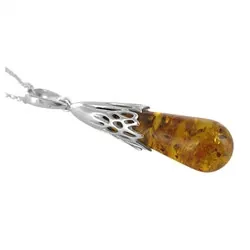
Amber and copal can look remarkably alike. Both begin as tree resin. Both may be clear, honey colored, orange or deep brown. Both can hold tiny bubbles, plant fragments or insects. That family resemblance is exactly why the two names are sometimes confused in jewelry listings.
The important difference is not whether one is beautiful and the other is not. It is whether a piece is described honestly. Amber is the far older material, transformed over geological time. Copal is younger resin that has started, but not completed, that long transformation. If you are comparing a vintage find, a loose specimen or a piece of jewelry, clear wording helps you understand what you are actually buying.
This guide gives you a practical way to think about amber vs. copal without turning a treasured piece into a home science project. Start with the seller’s description, use visual clues as prompts rather than proof, and save any damaging test for trained specialists.
The short answer: age and transformation
Amber is an organic gem, not a mineral crystal. Ancient tree resin was buried and changed through time, heat and pressure. The Gemological Institute of America explains that amber formed tens of millions of years ago, while copal is related resin that is younger than one million years old. That is a useful starting point, but age is really shorthand for a deeper change in the material.
As resin matures, its molecules link together and volatile compounds are lost. Gemological research describes this as polymerization and related chemical changes. In everyday terms, amber has had far more time to become stable. Copal is still natural resin, but it is less mature. Neither label should be treated as an insult. They simply describe different points in a long natural process.
For a jewelry buyer, that difference matters because it can affect durability, collecting interest and price. A seller can offer attractive copal honestly. Trouble begins only when a younger material is presented as ancient amber, or when a vague name such as “amber resin” avoids saying what the stone actually is.
The What Is Baltic Amber guide offers a closer look at the ancient material often used in Baltic jewelry.
Why appearance alone is not enough
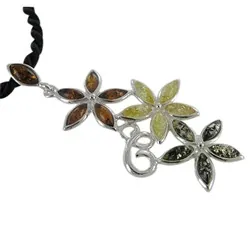
Color is not a reliable dividing line. Amber can range from pale lemon to cognac, cherry, greenish tones and near-black. Copal can also be transparent, yellow or warm orange. Clarity is no shortcut either. A clear stone may be amber, copal, glass or a manufactured resin. A cloudy stone may be naturally included amber, but cloudiness on its own does not establish age.
Inclusions deserve the same restraint. An insect or leaf can make a piece fascinating, yet insects can occur in both amber and copal. The American Museum of Natural History’s amber collection includes copal with many insect inclusions. So a very fresh-looking insect is a reason to ask questions, not a reason to announce a verdict from a photograph.
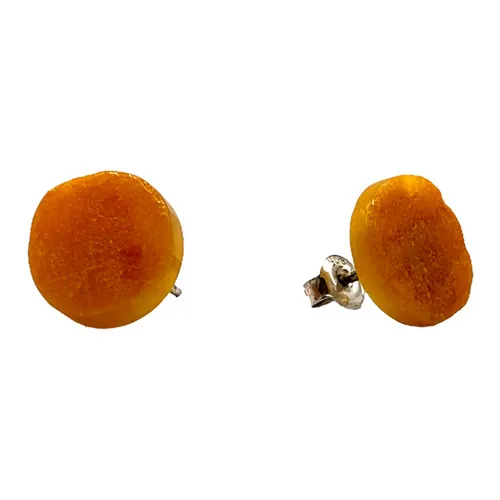
Surface condition can offer a clue. Copal may show fine cracking or a fresher, more resin-like appearance, while older amber can look more settled or weathered. But polishing, heat treatment, a protective setting and normal wear can obscure these differences. A single visual clue is never the whole story.
That is why confident shopping starts with description and provenance. Ask where the material came from, whether it is called amber or copal by the seller, and whether the answer is supported by a gemological report when the claim or price makes that worthwhile.
Tests to leave to a professional
You may find internet advice suggesting acetone, solvents, hot needles, flames or scratching. Those are poor choices for finished jewelry. They can permanently damage the stone, loosen a setting, harm a finish and leave you with less information than you started with. A piece does not become more authentic because it survived a risky kitchen experiment.
Specialists may use magnification, ultraviolet response and other observations as part of a wider assessment. When a definitive answer is needed, laboratory methods such as infrared spectroscopy can examine the material without relying on a destructive home test. A 2023 study in the Journal of Thermal Analysis and Calorimetry notes that the different degrees of polymerization in amber and copal are central to distinguishing them.
For a casual purchase, you usually do not need a laboratory. A clear material description, detailed photographs, a seller who answers direct questions and a sensible return policy are often the most useful safeguards. For a costly specimen, an unusual inclusion or an item being bought as a collectible, independent identification can be money well spent.
If you are checking whether jewelry is natural amber rather than a look-alike, the guide to telling if amber is real explains the questions worth asking without encouraging damage to your piece.
- Do not use heat, flame, a hot needle or solvents on finished jewelry.
- Do not scratch the surface to test a piece you want to keep or return.
- Use appearance as a conversation starter, not proof of origin or age.
- Seek a qualified gemologist or laboratory when a high-value claim needs confirmation.
How to read a jewelry listing with confidence
Good listings use the right words. “Natural amber” identifies the material directly. “Baltic amber” adds a geographic and trade context. “Pressed amber” describes fragments joined together under heat and pressure. “Copal” describes younger natural resin. “Resin” by itself may be too broad, because it can mean natural resin or a manufactured imitation depending on context.
Look for material information before romantic language. A phrase such as “glowing golden treasure” may describe the mood of a piece, but it tells you nothing about what it is made of. Clear photographs from more than one angle, a stated metal, a complete material description and a straightforward returns policy are more useful than a dramatic origin story.
It is also reasonable to ask about treatments. Amber may be heat treated to change clarity or create internal sparkle. Treatments do not automatically make a piece less lovely, but they should be disclosed when they matter to a buyer. The same principle applies to copal, pressed amber, composites and imitations: honest naming gives you the freedom to decide.
At Andzia’s Amber Jewelry, the focus is on natural Baltic amber selected from small artisan workshops and framed in sterling silver. Because each stone varies in color and interior character, the most satisfying choice is usually the one whose real details appeal to you, not the one with the loudest claim.
The buying checklist that matters
A little patience protects both your budget and the pleasure of choosing. Read the materials line before falling for the color. Compare the description with the photographs. If the phrase “rare amber” is doing a lot of work, ask what makes it rare and how that claim was established. A thoughtful seller will welcome a sensible question.
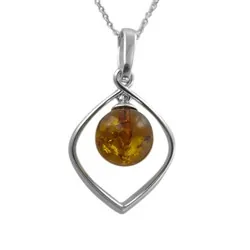
For wearable jewelry, craftsmanship and care also matter. Amber is softer than many gemstones, so a setting that protects an exposed edge can be useful. Once you own a piece, keep it away from perfume, hairspray, harsh cleaners and hard knocks. The site’s Amber Care guide has everyday care advice for preserving its surface.
If you are ready to choose a piece for its color, warmth and individual character, browse the Baltic amber jewelry collection. It is a better starting point than chasing a label you cannot verify from a single picture.
- Is the material named clearly as amber, copal, pressed amber or imitation?
- Do the photos show the actual piece from more than one angle?
- Can the seller explain origin, treatment and construction in plain language?
- Is the price supported by the material, craftsmanship and documentation, not just a dramatic story?
- Does the seller offer enough information and a reasonable return path for you to decide calmly?
What the terms in a listing actually mean
A few terms are easy to mix up. Natural amber means a piece was formed from resin and fossilized in nature. Baltic amber is a widely used trade description for amber associated with the Baltic region, prized in jewelry for its history and color range. Copal is natural but younger resin. It should be named as copal, not tucked behind a vague phrase that sounds more ancient than the material is.
Pressed amber, sometimes called ambroid, is different again. It is made by joining smaller amber pieces under heat and pressure. A maker may use it for a consistent color or a larger form. It can be perfectly legitimate jewelry, provided the construction is described accurately. A composite can combine more than one material, and an imitation may be glass or manufactured resin made to resemble amber.
These distinctions are useful because they separate materials from value judgments. A person may prefer an old natural cabochon for its history, a pressed piece for its color, or a modern resin piece for its look and price. The honest seller’s job is not to tell you which preference is correct. It is to give you enough information to recognize the choice you are making.
When you see an unfamiliar word, slow down rather than guessing. Ask for a plain-language explanation, then compare it with the photographs and price. A clear answer is a better sign than an elaborate story.
A calmer way to choose an amber piece
The best shopping decision is rarely made by trying to solve every scientific question from a thumbnail image. Begin with what you can know. Is the seller naming the material? Are the photographs close enough to show the actual stone? Does the setting look carefully made? Is there a return path if the piece is not what you expected? These practical details do more for confidence than a dramatic claim about age.
Then make room for taste. Amber is special because it refuses to look factory-perfect. Some stones are transparent and bright, others look softly clouded or hold tiny traces of their natural journey. A piece can be beautiful because of its warmth, its silverwork, its color or the way it changes in daylight. Those are reasons to wear it every day, with no need to turn it into a museum specimen.
If a piece is being bought as an investment, a rare inclusion or a major collectible, the standard changes. Get the documentation appropriate to the price and do not let urgency replace evidence. For ordinary jewelry, choose a trusted source, read the description closely and let the actual piece be the reason you say yes.
Frequently asked questions
Is copal fake amber?
No. Copal is natural tree resin, not automatically an imitation. It is younger and less fully transformed than amber. It becomes a problem only when it is described or sold as a different material than it is.
Can you tell amber from copal by looking at it?
Sometimes appearance can raise useful questions, but it cannot reliably prove the difference. Color, clarity, bubbles and inclusions can occur in more than one material. A clear description and, when needed, professional identification are more dependable.
Should I test an amber necklace with acetone or heat?
No. Solvents, heat and scratching can damage a stone and its setting. They are especially risky for finished jewelry. If the material needs confirmation, a qualified gemologist or laboratory can use safer methods.
Does an insect inside prove a piece is amber?
No. Insects and plant material can be trapped in both amber and copal. An inclusion may be interesting, but it does not independently prove the age or identity of the surrounding material.
Is copal less valuable than amber?
Value depends on the exact piece, its condition, craftsmanship, provenance and market. Amber’s greater age can matter to collectors, while a well-made copal piece can still be attractive. The key is that the material and price are represented honestly.

